
'Good food is so expensive and bad food is so cheap. What people need to have is fresh, wholesome produce.'


Rx for Virginians’ health, one grocery bag at a time


Story by Elizabeth McGowan

Photographs by Carolyn Van Houten

Design by Kunle Falayi

Virginia Center for Investigative Journalism at WHRO


THIS STORY WAS SUPPORTED BY THE PULITZER CENTER.

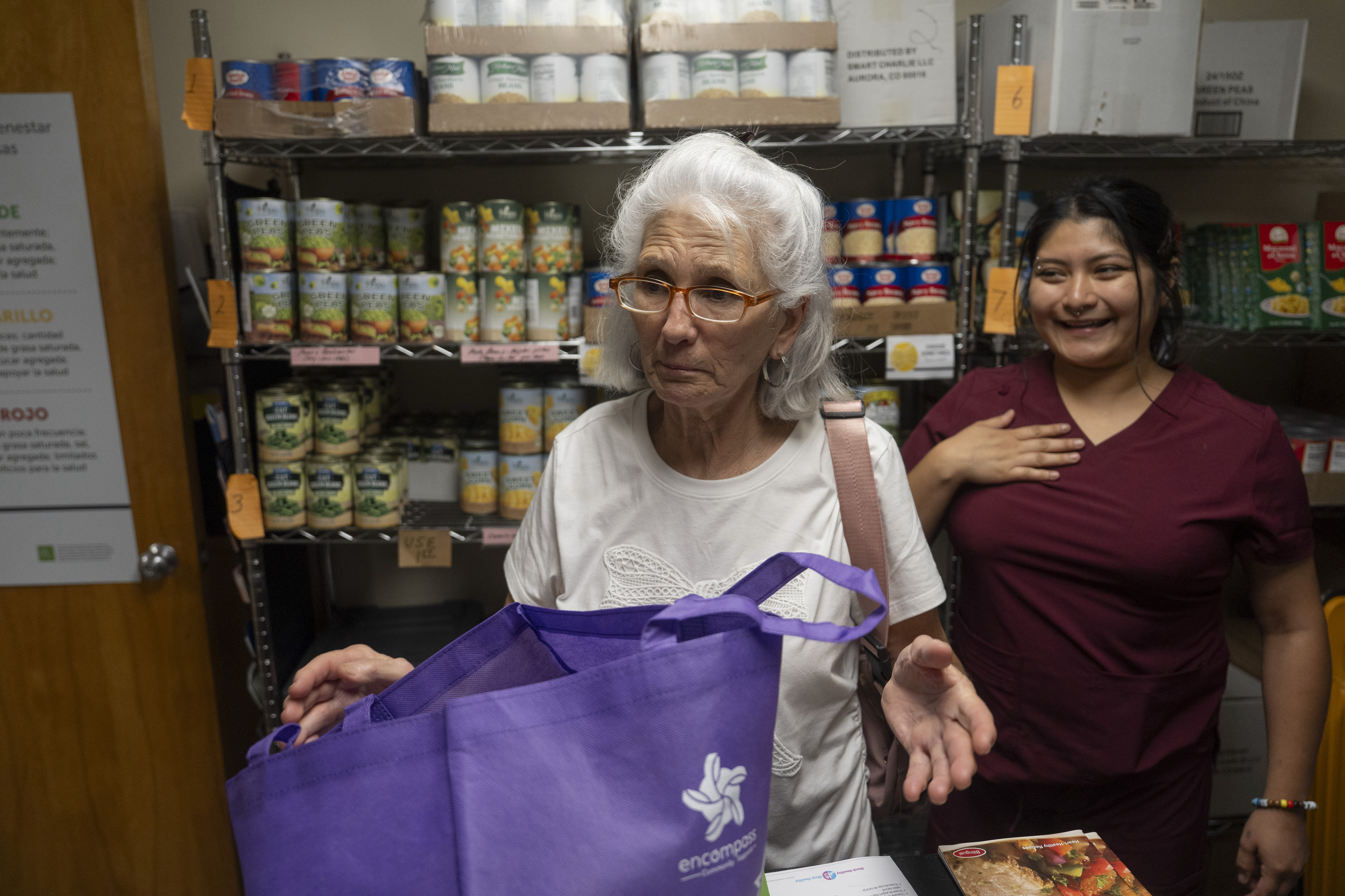
Medical assistant Michelle Rojo guides Judith, a patient with diabetes, around the Free Clinic of Culpeper’s food pharmacy on Aug. 26. It’s one of 99 food pharmacies across Virginia. The idea behind the relatively new concept is to help low-income patients follow through on specific advice they receive during their regular checkups by making healthy diet choices. Clients also have access to a local gym.

CULPEPER, Va.—On a boiling hot August afternoon, Judith pops into the Free Clinic of Culpeper days before her regular checkup because she feels “a little off.”

An abnormal blood test reveals she is wise to trust her instincts. Still, the staffer on duty assures Judith there is no need to panic—if she balances eating well with taking the prescriptions that regulate her diabetes and high cholesterol.

“Phew,” utters the slender 74-year-old. As a patient since 2018, she is aware that not all medicine comes in vials. That’s why she eagerly follows medical assistant Michelle Rojo to a corner room stacked with cans of meat, beans and fruit, and containers of low-fat milk and yogurt, oatmeal, rice, pasta and more.

“Our patients are like family to us,” Rojo says about the clinic’s food-is-medicine mantra. “We know their stories, their struggles and why it’s hard to change eating and exercising habits. Some just need a little push when they fall off the wagon.”

“Our patients are like family to us,” Rojo says. “We know their stories, their struggles and why it’s hard to change eating and exercising habits. Some just need a little push when they fall off the wagon.”

Refrigerators and freezers in a separate clinic room are part of the food pharmacy at the Culpeper Free Clinic. Food is delivered by the Blue Ridge Area Food Bank in Verona and by local farmers. Culpeper’s pharmacy, which served 600 patients in 2025, aims to address both health and food security issues.

Each patient in Culpeper receives recipes, as well as culturally appropriate food and spices, to encourage them to cook for their friends and families. Other handouts offer tips on reading nutrition labels, eating a balanced diet, and cutting back on salt, sugar and processed food.

Rojo, morphing into her personal shopper role, fills a cloth bag with tortilla mix, dried beans, canned vegetables and a pamphlet of low-sodium and non-sugary recipes. Before darting down the hall to retrieve a package of lean ground turkey from the freezer, Rojo reminds Judith about limiting her portions and eagle-eyeing nutrition labels in the grocery store.

Steps away, Judith’s last stop is a table overflowing with fresh tomatoes, greens, peppers, cucumbers, corn and other seasonal bounty harvested from the clinic’s front-yard raised beds or donated by area farmers.

This one-grocery-bag-at-a-time scenario is repeated dozens of times daily at a network of 99 statewide sites where needy Virginians—many with chronic diseases living in food deserts—are “prescribed” the ingredients to prepare healthy meals at home.

Culpeper County farmer John Clark, who served as the ninth director of the U.S. Marshals Service, drops off sweet corn at the clinic’s food pharmacy on Aug. 25. He retired after a long career working in law enforcement, as a security operations director for Lockheed Martin and as CEO of the National Center for Missing & Exploited Children.

“Our goal is to see this produce go down the driveway to people in need,” Clark says about his volunteer labor at Harvest & Hope Farm.

Food pharmacy volunteer educator Carolina Gomez hands patient Baltazar Meza locally grown peppers after the 71-year-old’s regular checkup at the Culpeper clinic.

“We’ve built relationships all over the county,” says clinic director Tammy LaGrange. “That’s what makes us a community hub. Our patients’ successes are our successes.”

Corn harvested at John Clark’s Harvest & Hope Farm in Culpeper County is a big hit at the food pharmacy.

The relatively new phenomenon of wrapping food pharmacy services into regular checkups is changing lives in Culpeper—and beyond.

But its continued success is in jeopardy.

Food as medicine is under severe strain due to Trump administration policies shrinking access to food stamps and health care for the poor.

One piece of that bleak equation is that 130,000-plus Virginians — including at least 23 in Culpeper County — are on the verge of losing eligibility for the Supplemental Nutrition Assistance Program. Those cutbacks are mainly because of new work requirements and other changes instituted under H.R. 1 in July 2025, according to Virginia’s Office of the Secretary of Health and Human Resources.

Never mind that Virginia’s food pantries could barely keep up with demand from cash-strapped residents struggling to pay their monthly bills. Shelves are barer because the Trump administration slashed one-quarter of a federal commodities program that provides up to one-third of pantries’ inventory.

“With less food coming in and trying to serve a record number of people, we are in a very challenging environment,” explains Eddie Oliver, executive director of the Federation of Virginia Food Banks. “Stretching resources doesn’t allow us to invest in food pharmacies, which have led to better health outcomes because of their targeted approach.”

In late August, Democratic Gov. Abigail Spanberger issued an executive order directing the state to protect healthcare coverage and food assistance for at-risk Virginians.

While Oliver lauds the governor’s diligence, he said “these gaps are going to be so extreme that it will be hard for Virginia to fully replace the funding we are losing.”

In 2023, his nonprofit joined with the Local Environmental Agriculture Project to launch the Virginia Food is Medicine Coalition. That amalgam of 68 organizations covering academia, advocacy, agriculture, government and healthcare exists to prove that nutrition should be folded into clinical care, not treated as an afterthought.

Volunteers from the Society of St. Andrews gathered at Harvest & Hope Farm in Culpeper County on Aug. 25 to pick, sort and deliver about 3,100 pounds of corn to charities throughout Virginia. The food pharmacy in Culpeper was on that list.

“We figure out how to get this done and help our fellow citizens,” Clark says. “The world works best with volunteers.”

Retired pharmacist Eugene Triplett is the volunteer staff pharmacist at the clinic in Culpeper and a fifth-generation area farmer. He mentors clients and also donates produce to the food pharmacy. Triplett linked farmer John Clark with the clinic by sourcing the seed corn he needed.

“Eugene is the thread that weaves through this entire volunteer and healthy food effort at the clinic and throughout Culpeper,” Clark says. “He is a gentle spirit with a good heart.”

During the growing season, local farmers provide the food pharmacy in Culpeper with an array of free, fresh vegetables. In addition, clinic volunteers plant, weed and maintain several vegetable and herb gardens outside the clinic’s front door.

Culpeper’s food pharmacy originated in October 2024 under the umbrella of the Verona-based Blue Ridge Area Food Bank.

“What I love is that we have a captive audience and the food pharmacy dovetails with what patients are told during their medical appointment,” director Tammy LaGrange says. “One screening question is ‘Do you need food? A ‘no’ answer is rare.”

Last year, it provided groceries for most of the 600 patients seeking health care, 90% of them Hispanic.

LaGrange expects that number to balloon in January when an estimated 1,800 county residents — of 300,000 statewide — are expected to be shut out of Medicaid because of non-compliance with work requirements. But the amount of food will stagnate.

Map of Virginia's counties and independent cities, with only Culpeper County highlighted in amber and all other localities in gray.

Source: Virginia Department of Health and Human Resources

Map boundaries: U.S. Census Bureau, 2024

“As somebody doing client education, this is disheartening,” says primary care coordinator Becca Buncie. “I have all this knowledge to share, but not always the resources to make it happen.”

LaGraffe and Buncie, both registered nurses, are already brainstorming how to finagle more food—whether that translates to writing another grant to procure 1,200 eggs or asking for extra from community connections such as John Clark, who has operated Harvest & Hope Farm for eight years.

Volunteer picker Dave Naser wades deep into the cornfield at John Clark’s farm in Culpeper County on Aug. 25.

Volunteer Frank Gibbs, left, gathered corn at the 166-acre Culpeper County farm of John Clark, right, on Aug. 25.

“My philosophy is, be generous with your own abundance,” Clark says, explaining what has motivated him to donate tons of sweet corn, potatoes, cucumbers, squash and tomatoes to the health clinic in Culpeper and other charities over the last eight years. “That’s what I aspired to do when I moved here.”

Clark, the retired director of the U.S. Marshals Service, provided much of the 570 pounds of corn and other produce that supplemented monthly deliveries of staples from Blue Ridge this year. He also hands out pepper and tomato plants to clients. Volunteers harvested another 260 pounds from the clinic’s front yard gardens.

“Good food is so expensive and bad food is so cheap," says Eugene Triplett, volunteer staff pharmacist at the Culpeper clinic. "What people need to have is fresh, wholesome produce.”

Clinic pharmacist Eugene Triplett admires photos that a co-worker, medical assistant Allie Mejía, took of her garden vegetables.

Triplett had adopted the “food is medicine” motto long before Culpeper’s food pharmacy opened in October 2024.

“We live in a world where there’s a lot of hopelessness,” Clark says. “Food is something that gathers hope around the table.”

Staff pharmacist and volunteer Eugene Triplett, a fifth-generation farmer in nearby Brandy Station, linked Clark to the clinic.

“My grandfather used to give away everything he grew,” Triplett says about sharing his bounty of tomatoes, peppers, greens, peppers, beans and cabbages. “Now I understand why that gave him such joy.”

Triplett, whose mother was a chef, delights in watching patients take a shine to newfangled concoctions such as zucchini lasagna. He’s fond of matching golden beets, spaghetti squash, watermelon radishes and other garden obscurities with recipes “to teach people to experiment with wholesome food outside of their cultural comfort level.”

As Trump-imposed cuts to food stamps and Medicare went through court challenges, LaGrange and Buncie are girding for leaner times.

“My biggest concern is continuity of care,” Buncie says. “If patients show up, we’re going to figure out a way to help them. If they don’t, we’re going to worry.”

Buncie points to the powerful clinical impacts of food pharmacies. Studies reveal that regular clients can significantly reduce their blood sugar, lower their blood pressure and lose weight. Another bonus is steep drops in household food insecurity.

One Culpeper woman, who asked not to be named, is living proof. During her first visit to the Free Clinic in 2018, she told staffers she was terrified that she, too, would succumb to the family curse of diabetes because she was so severely overweight.

Fast forward eight years. The 45-year-old mother explains that trading junk food for food pharmacy fare, an intensive walking regimen and medication have helped her shed 60 pounds.

“Food can be such easy comfort,” she says. “But once you start losing, the aches and pains are less. You just start to feel better and that motivates me to keep going.”

Recently, the clinic prescribed a GLP-1 drug so she could maintain that trajectory and ditch her diabetes-control pills.

These days, the woman’s first question at the clinic is, “Hey, do you mind if I weigh myself?” before hopping on the scale – and eliciting high-fives from staffers.

For her, the low-slung, red brick building housing the food pharmacy is a refuge. She emphasizes how thankful she is for the circle of big-hearted professionals who care so deeply about her well-being.

“I don’t need a medal for what I’ve achieved,” she says. “A kind word is more than enough.”

Farmer John Clark delivers sweet corn to the food pharmacy at the Free Clinic of Culpeper.

“What it takes to take a seed, grow it, harvest it, and deliver it is a journey,” Clark says. “It is months of preparation and work to get the seed beds ready and the corn as good as we can make it.”

Reach Elizabeth McGowan at elizabeth.mcgowan@whro.org.

© Virginia Center for Investigative Journalism at WHRO.