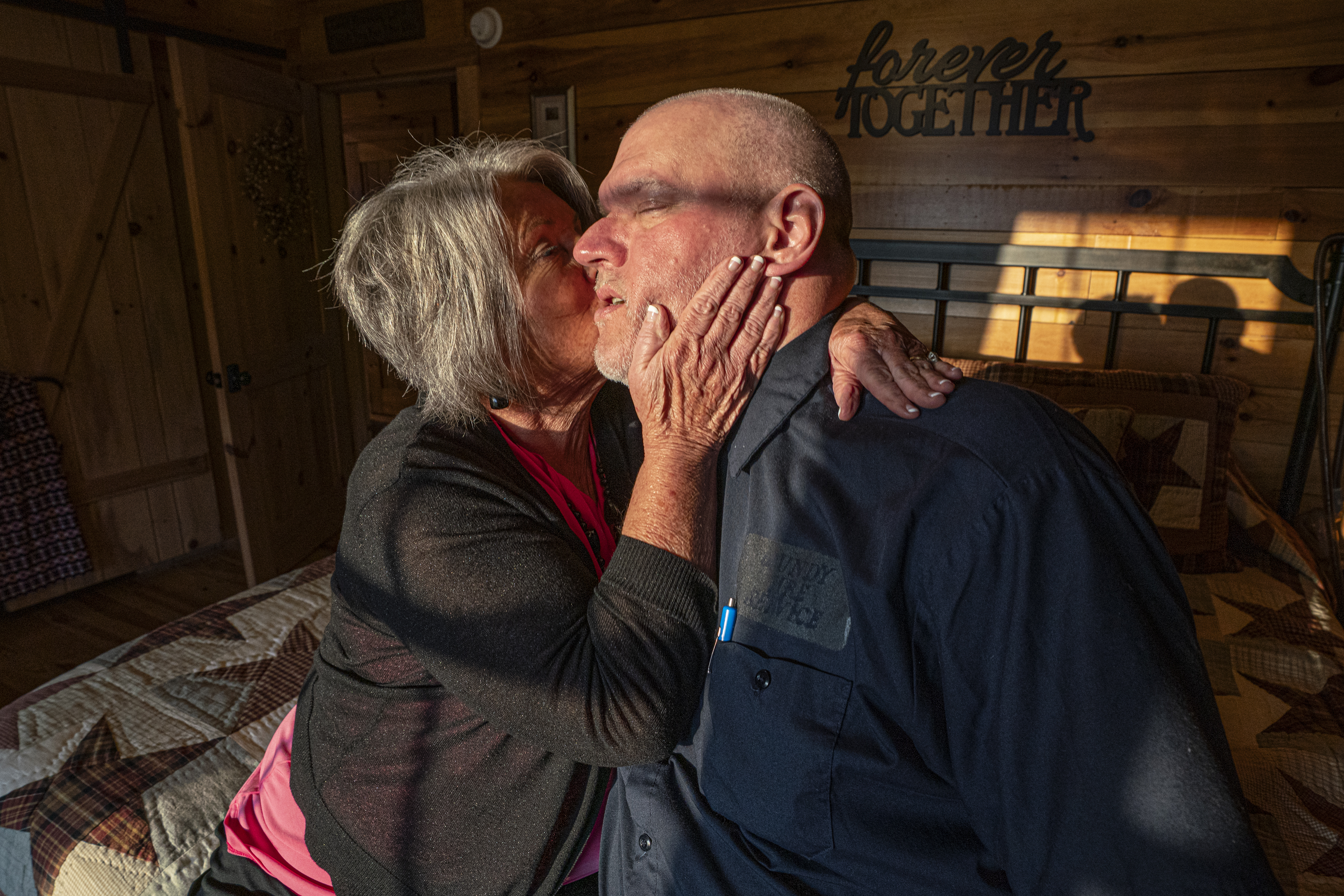

As coal production in Southwest Virginia wins White House support, miner protections stall under the Trump Administration. Miners, their families, and the community struggle with the illnesses the industry leaves behind.

Rotate your phone animation

A plaque with the words “forever together” hangs over Vonda and John Robinson’s headboard in their Nickelsville, Virginia, bedroom. It is a promise that coal mining makes hard to keep.

Living for Coal, Dying for Breath


By Christopher Tyree

Photographs by Karen Kasmauski

Virginia Center for Investigative Journalism at WHRO


THIS STORY WAS SUPPORTED BY THE PULITZER CENTER.

A small pile of coal extracted from a mine in the Roaring Fork area of Dickenson Dickinson County on March 11, 2026. Drone image by Bill Douthitt for VCIJ.

More than 40 years ago, on a Friday night whim, Vonda and John Robinson decided to get married in a minister’s basement. She wore jeans and sandals. He wore a grin.

Later, with two young daughters darting through the small trailer he’d purchased, John took a job he had sworn he would never do. He went into the coal mines.

Vonda didn’t want him to go, but few jobs in Southwest Virginia paid enough for an “American dream.” It was the life he wanted to build for the women he loved.

Twenty-eight years later, that dream vanished.

John, once broad-shouldered and strong as the granite he smashed, emerged from the mines with a broken body and failing lungs. He was diagnosed with black lung disease in 2014, which left him with about 60 percent of normal capacity. His days in the deep dark were done.

Today, a beeping oxygen tank is a new appendage.

He is slowly suffocating — the cost of cutting through the rock that has powered lives far beyond these hills.

While John, 60, has slowed, Vonda has not.

Since his diagnosis, Vonda, 64, has become a relentless advocate for miners and their families.

Today, she is the vice president of the National Black Lung Association, an advocacy group that pushes for safer workplaces and financial protections. The work is as hard emotionally as the rock beneath her feet. Her phone rings constantly.

In the last year, those calls have taken on new urgency.

“As long as I have breath in me, I'm going to fight for every coal miner and for every widow, because that's my heart. I live with it every day. As long as I have breath, I'm going to push. I'm going to try.”

Beautiful Clean Coal

"We've had a good life. Was able to buy my wife a nice vehicle, nice home. Kids had nice things. Coal was good. …But that's the price you pay, because at the end, when it's all said and done, your health is gone. Your breathing is gone. Your joints are wore out. But, I'd do it again….I like coal mining….It was hard when they pulled me out, real hard."

During a ceremony at the White House on February 11, 2026, President Trump was presented with a metal sculpture of a coal miner by industry representatives. Etched into the base were the words “Undisputed Champion of Coal.”

The event was capped by his signing of an executive order directing the Pentagon to increase coal power usage at military bases across the United States, to the applause of coal operators and miners standing behind him.

“I know you well,” Trump said during the media event. “I think I got about 97 percent of your vote.”

John’s was one of them.

A mine site in the Roaring Fork area of Dickenson County, Virginia, March 11, 2026.

An underground personnel carrier emerges at the end of a shift from a mine in the Roaring Fork area in Dickenson County.

A loader works a coal pile at Tom Creek, near Coeburn, Virginia. Trains are loaded up to ports, and Virginia coal is shipped all over the world.

A coal truck hauls a load to the Virginia City Hybrid Energy Center in St. Paul, Virginia, on March 12, 2026. The power plant has been in operation since 2012.

Four months earlier, coal miners, members of the National Black Lung Association, and their supporters had rallied in front of the U.S. Department of Labor. They pleaded with the Trump administration to enforce a rule meant to protect miners from silica dust — a toxin released as workers cut through rock to reach thinning coal seams.

Federal health officials warned as early as 1974 that silica dust could cause severe and irreversible lung disease. Yet coal miners have long been allowed exposure levels roughly twice those permitted in most other industries.

Under the Biden administration, the Mine Safety and Health Administration (MSHA) finalized a new rule setting stricter limits on miners’ exposure to silica dust. Federal courts stayed the rule in April 2025, days before it was to take effect. The Trump administration has not provided a timeline for enforcement or indicated whether it plans to enforce it.

“We’re seeing miners born in the 1980s, even the 1990s. They’re getting exposed to a lot more coal dust and other dust factors, silica being one,” said Brad Johnson, a lay representative who has spent more than 20 years working in the black lung program at Stone Mountain Health Services in Southwest Virginia.

John Robinson, right, talking with his friend, mine superintendent Tivis Johnson, at a mine in the Roaring Fork area in Dickenson County, Virginia, March 11, 2026.

John Robinson, standing at center in a black shirt and sunglasses, joins about 100 mine workers and supporters outside the Department of Labor on October 14, 2025 to protest the Trump Administration’s policies towards miners with black lung. Photo by Jordan Tovin // VCIJ

At the miners’ rally in Washington last October, John leaned hard on his wooden walking stick, wearing a black T-shirt emblazoned with an image of a skeleton in a miner's hat and the words Black Lung Kills. Vonda, who organized the event that brought more than 100 miners from across the East Coast to D.C., stepped to the microphone.

“We’re tired of seeing 28-year-olds with complicated black lung. We saw a 35-year-old die last week. These people are not going to see their children grow up,” she told the crowd. ”They deserve to be able to breathe, they deserve to be able to go home to their families. We’re here to make America healthy again, too.”

Political leaders back coal companies, she said, but without miners, there is no industry.

“We’re asking President Trump, Vice President Vance, and Congressman Griffith to get this done. We need your Republican support to get this passed because, without this, it’s an early death sentence for our miners.”

“Beautiful clean coal” has become a recurring phrase in Trump’s push to expand coal production. In a March 2025 executive order, Trump elevated coal to mineral status, trying to clear the way to mine federal lands and eliminate environmental roadblocks.

Ramping up production and prioritizing coal comes with a cost, Vonda says.

“I want them to be accountable for the health and safety of our coal miners. Somebody has got to listen.”

Vonda speaks with Brian Sanson, President of United Mine Workers of America, after a roundtable discussion with U.S. Sen. Mark Warner, D-VA, on March 12, 2026 at UMWA office in Castlewood, Virginia. Vonda works with UMWA representatives to advocate for safer work conditions for coal miners.

“As Long As I Have Breath In Me”

Sitting on his oversized leather couch, Danny Hicks, 71, used to fill out the gray henley and blue jeans he still wears. He was diagnosed with complicated black lung disease. Over the last few months, the former miner has shed more than 55 pounds, and the clothes now hang loosely on his frame. His body shakes, his joints ache, and each breath comes harder than the last.

Vonda talks with Hicks at the black lung clinic run by Stone Mountain Health Services in Haysi, Virginia, about his upcoming doctor’s appointment on March 12, 2026.

Dr. Drew Harris, a rural-health-focused pulmonologist at UVA Health, examines Danny Hicks at Stone Mountain Health Services in Haysai. He has been documenting Hicks’ condition and preparing materials for the former miner’s benefits appeal in July.

Vonda Robinson catches up with Dr. Harris in the lobby of Stone Mountain Health Services. John Robinson, at right, has been a patient of Dr. Harris’ for several years. Harris drives to health clinics in Southwest Virginia several times a month to treat miners with black lung disease.

Vonda and John pulled their silver Suburban up to a modest brick and vinyl house sitting atop a hill in St. Paul. Danny Hicks met them at the door with a smile.

In his working days, Hicks cleared coal and rock dust from his goggles so he could drill roof bolts into the mine ceilings, stabilizing the shafts.

A shelf beneath the family’s television held his memories — photos of his son, whom he helped keep out of the mines by buying him rental property, and his father, who died of black lung.

He wiped away tears, grateful his son won’t relive his fate, and fearful as he realizes what’s ahead for him.

“We’re here to fight with you. Danny, I ain’t letting you give up,” Vonda said, gently touching his arm.

Danny and his wife, Thersea, dreamed of traveling the country after he retired from his 38-year career in the mines. But soon after, he knew something wasn’t right. He went to the Stone Mountain clinic for breath tests, X-rays and CT scans. The diagnosis: complicated black lung.

On paper, Danny believed he qualified for the U.S. Department of Labor’s 15-year presumption rule. If a miner has worked at least 15 years underground and develops a respiratory or pulmonary disease, it is presumed to be black lung. But when Danny went to court a decade ago, coal company lawyers challenged his medical assessments. Two years later, a judge denied his claim.

Brad Johnson, right, consults with Hicks. Johnson, a miners’ advocate, says initial denials of benefits are common. The appeals process can stretch on for years. Miners joke that the courts are trying to run out the clock so coal companies won’t have to pay benefits.

Danny’s appeal goes before the courts again in July. Vonda and John have supported him through the process, but Danny doesn’t believe the outcome will be different this time.

“These judges that come down here to hear these cases—they absolutely know zero about coal. Nothing,” Danny said, his voice fading.

Danny’s wife returned to work at a grocery store pharmacy about 30 minutes away, coming out of retirement to pay for his medications — prescriptions that would be covered under the black lung benefits program.

After encouraging Hicks to eat and reassuring him about his appeal for benefits, John Robinson offers a prayer.

“Lord, cure these old lungs, it’s all messed up, and touch his shoulders, his knees. Lord, whatever’s ailing him, He's in need. He's sick. There's a lot of us that are sick. Lord, we all need you. And I pray, Lord, that you’ll intervene and get this man what he deserves.”

The next day, Vonda and John traveled the winding roads of Southwest Virginia to meet Pam Stacy in Coeburn.

Pam and Herbert were high school sweethearts. Before the oxygen tanks and hospital stays, he was the kind of man who didn’t know a stranger, who called everyone “honey,” who worked long hours underground and carried it as a point of pride. He was affectionately known as Frog.

Frog died in 2020 from complications with black lung. If he were still alive, the couple would have celebrated their 50th wedding anniversary last year. Like so many miners, Frog did the work because he loved his family and wanted the best for them, Pam said.

Pam Stacy of Big Stone Gap, Virginia, lost her husband, Herbert “Frog” Stacy to black lung disease in 2020 after several years of struggling with the disease. She holds the urn of his remains on March 11, 2026.

Vonda Robinson, right, reviews paperwork for black lung survivor benefits with Pam Stacy at her home in Big Stone Gap. The Department of Labor granted Pam and her husband black lung benefits, but his former employer successfully disputed the decision. Stacy, a widow, is being forced to repay past benefits. Vonda has been working with Pam to appeal the decision so she can qualify for survivor assistance.

Vonda shares a hug as she leaves Pam’s house. The work of advocating for miners and survivors has brought Vonda into many close relationships.

After leaving the mines, Frog was initially granted black lung benefits through the Department of Labor (DOL). But years later, after numerous doctor visits, rehab, oxygen tanks and countless nights spent changing the blackened filters in his ventilator, he lost those benefits after the coal company appealed.

The DOL told them to repay the benefits they had received. The ruling also meant that future medical treatment would no longer be covered. His health quickly deteriorated.

Vonda and Pam shuffled through the mounds of paperwork spread across the dining room table, each stack carefully organized. Pam is preparing her appeal for widow’s benefits, a process that has taken years, requiring her to track down every receipt related to her husband’s illness and spend thousands on an autopsy.

Pam Stacy reads her letter for Mark Warner
0:00 0:00

Vonda knows that she, too, will one day face the challenges brought on by John’s eventual death.

Her work helped lead to legislation last December by Virginia Senators Mark Warner and Tim Kaine, along with U.S. Rep. Morgan McGarvey, D-Kentucky. The Relief for Survivors of Miners Act would ensure that families of miners who died from black lung are properly compensated. The bill has yet to reach committee.

The day before announcing his reelection campaign in March, U.S. Sen. Mark Warner, D-Virginia, meets with United Mine Workers of America representatives, healthcare workers, lawyers and miners at the UMWA office in Castlewood, Virginia. Vonda sat beside him.

Senator Warner discusses miner benefits with United Mine Workers of America representatives, advocates and miners at the UMWA office in Castlewood, Virginia. Vonda, left, represents miners and widows who haven’t received their benefits.

“I visited a coal mine and handed out my cards,” Vonda told the audience. “I asked them, ‘Have you been checked?’ And the first thing they said was, ‘No, I’m scared. I’m afraid I’ll lose my job.’”

She said she didn’t know what it would take to make politicians in Washington react.

“They’re saying, ‘Dig, baby, dig.’ Okay—then let’s make our miners healthy again. Let’s make them safe again. I’m telling you, these miners need to be protected.”

The room broke into applause.

In the waning afternoon, Warner wrapped up his appearance at the union hall, acknowledging the difficulty of passing legislation in the current political climate.

He pointed to small steps his office might take, but also alluded to the political reality of the region that voted overwhelmingly for Trump.

After a long day traveling the Southwest Virginia countryside and meeting with miners and widows, Vonda and John leave their local restaurant in Nickelsville, Virginia. Each carries their vital equipment —a portable oxygen tank and a phone.

Dead vines hang on empty coal cars in the town of Dante on March 13, 2026. Despite the White House push for coal production. Data from the U. S. Energy Information Association shows that the amount of coal mined in Southwest Virginia hasn’t grown in the last two years.

John Robinson spends as much time as he can with his 8-year-old granddaughter, Millie. She shows her grandfather a game on her tablet while they enjoy an evening on the Robinsons’ front porch on March 11, 2026. Millie has learned how to operate John’s oxygen machine in case of an emergency.

At their home in Nickelsville, a dull gray of evening falls over the Appalachian hills, casting John’s old mining helmet and lunch pail on a small table outside in a cold, bluish light.

Beneath the mountains beyond their porch, the seams run thin.

Inside, the house is quiet. The hum of John’s oxygen tank sets a steady rhythm as they sit together on their leather love seat.

Vonda’s phone breaks the silence.

Another widow.

She wants to know where to begin.

John’s lunch pail and miner’s helmet, remnants of his past, sit on a table outside the Robinson’s home in Nickelsville on Mar 11, 2026.

Reach Christopher Tyree at chris.tyree@vcij.org, Karen Kasmauski at kkasmauski7@gmail.com